
3D Blow Molding Machine - Suction Technology
3D Blow Molding Machines — Suction Technology | Official India Supplier of STBLOW
What is 3D blow molding – suction technology?
3D blow molding suction technology (3D SBM) is a specialized extrusion blow molding process designed specifically for producing curved, convoluted, and tubular hollow parts — such as automotive air ducts, coolant pipes, fuel filler pipes, and HVAC hose assemblies — that cannot be produced economically or without flash by conventional blow molding.
In conventional extrusion blow molding, the parison hangs vertically under gravity and is captured by a mold that closes around it. For curved or 3-dimensional tube paths, this creates heavy flash at the extremities and requires extensive post-processing. In 3D blow molding section technology, the parison is actively sucked through the nearly closed mold cavity by a vacuum system, following the exact 3-dimensional path of the part, eliminating flash almost entirely and producing near-net-shape parts in a single operation.
STBlow is the acknowledged global market leader in this technology, and Ulai is their official sales channel for India, Sri Lanka, Bangladesh, and Nepal.


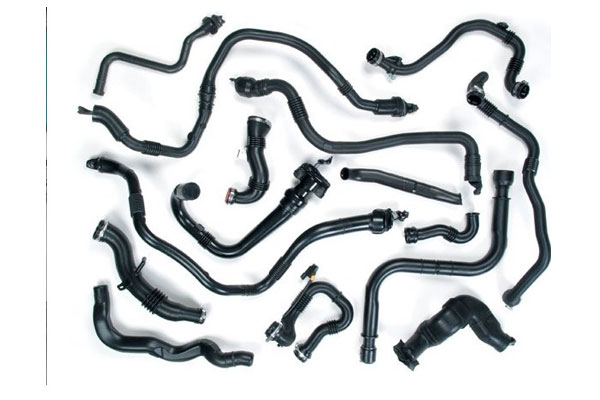
Why automotive manufacturers choose 3D suction blow molding
- Zero or near-zero flash — eliminates the secondary deflashing and trimming operations required with conventional EBM for curved parts, significantly reducing per-part cost
- Complex 3D geometries in a single shot — produce curved, convoluted, and multi-bend duct assemblies that would require multiple injection-molded parts and assembly if made by other processes
- Engineering plastic compatibility — Machine can process crystalline engineering materials including Nylon (PA6, PA66), PPS, PPA, PBT and other high-performance polymers that conventional EBM machines struggle to process reliably
- Better surface finish — because the parison moves while the mold is closed, temperature is more precisely controlled throughout the blow cycle, resulting in superior inner and outer surface quality
- Lower energy consumption — STBlow's machines are among the most energy-efficient in the global market for this technology class
STBlow ASPI — key technical features
4WDS — unique radial wall thickness control
STBlow's proprietary 4WDS (4-Way Distribution System) provides both longitudinal and radial wall thickness control with a full 500-point programming system. This enables precise material distribution through the bends and varying cross-sections of complex 3D parts — ensuring structural integrity where it is needed and minimizing weight and material use throughout. Easy mechanical centering simplifies setup when changing molds.
Mono-layer, SECO, and dual station configurations
Available in mono-layer (single material), SECO (single extrusion, multiple colours or layers for specialized applications), and dual-station configurations for higher output requirements. Dual-station machines allow one station to be blow-molding while the other is being loaded and unloaded — significantly increasing machine utilization and output per hour.
Engineering plastic processing capability
Unlike most blow molding machines which are optimized for HDPE and PP, STBlow's ASPI series is specifically designed to process demanding engineering plastics: crystalline nylon (PA6, PA66), PPS (polyphenylene sulphide), PPA, and other high-melting-point crystalline materials. This is essential for automotive under-hood applications where parts must withstand temperatures exceeding 150°C in continuous use.
Higher plasticising capacity
STBlow's ASPI extruder designs deliver higher plasticizing capacity from smaller screw sizes — translating to faster cycle times and higher productivity without increasing machine footprint or energy demand.
IO-Link device integration
STBlow machines incorporate IO-Link device connectivity for preventive maintenance monitoring, remote access, and diagnostics. Fault prediction and planned maintenance intervals can be managed remotely — reducing unplanned downtime. STBlow-proprietary parts are clearly identified and trackable through the system.
Parison lubrication and marking system
An integrated parison marking and lubrication system ensures smooth parison movement through the mould cavity during the suction phase, reducing parison wall damage and ensuring consistent part surface quality across high-volume production runs.
Typical applications
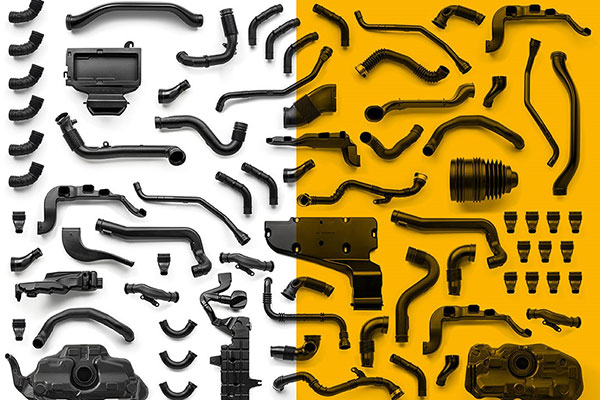
- Automotive air intake ducts and charge air cooler (CAC / intercooler) pipes
- Automotive coolant hoses and radiator pipes in crystalline nylon
- Fuel filler pipes and fuel vapour management lines
- Automotive HVAC distribution ducts
- Turbocharger hoses and boost pressure pipes
- Industrial fluid handling hoses and convoluted tubes
- Urea (AdBlue / DEF) tank supply lines
Materials processed
- Crystalline polyamide (PA6, PA66, PA12) — standard and heat-stabilised automotive grades
- PPS (polyphenylene sulphide) — for extreme-temperature applications
- PPA (polyphthalamide) — high-temperature nylon for under-hood
- HDPE and PP — for non-critical duct and fluid line applications
- TPV / TPE / TPC — for flexible duct sections and convoluted bellows

 Whatsapp Us